

KeyGree TSMJQ-01 Tungsten Electrode Grinder: The Precision Edge for Perfect TIG Welding Every Time
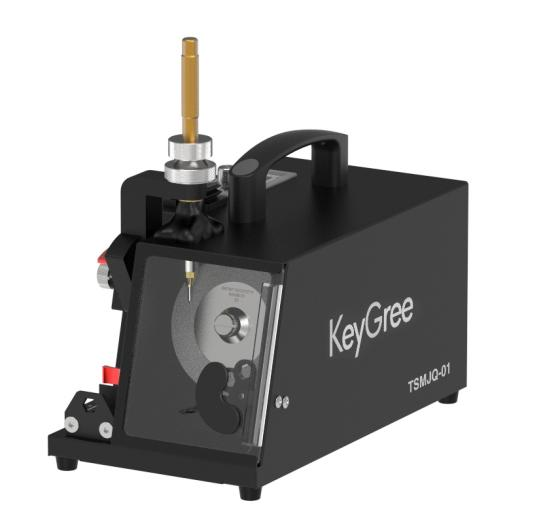
KeyGree’s TSMJQ-01 Benchtop Tungsten Electrode Grinder transforms this subjective art into a repeatable science — ensuring that every weld, critical or routine, starts from a perfect, predictable electrode.
The High Cost of Imperfect Preparation: Why “Good Enough” Isn’t Good Enough
For decades, welders have relied on manual methods—handheld grinders, standard bench wheels, or even abrasive belts—to shape their tungsten electrodes. This approach introduces significant, often hidden, costs and risks that directly compromise product quality and operational efficiency.
1. The Physics of Failure: How Poor Geometry Destroys Weld Integrity
A tungsten electrode is the conduit for the welding arc. Its tip geometry controls the arc's shape, density, and stability.
Unstable, Wandering Arcs: An uneven grind with irregular angles or microscopic grooves causes the arc to flare, dance, or deflect. This results in inconsistent bead width, uneven penetration depth, and lack of fusion—defects that may not be visible on the surface but critically weaken the joint.
Increased Contamination & Porosity: A rough, transversely ground surface (common with handheld methods) can cause the arc to "spit," ejecting microscopic tungsten particles into the molten weld pool. These inclusions become permanent stress points and potential failure initiation sites. Furthermore, an unstable arc can fail to properly shield the pool, leading to atmospheric contamination and porosity.
The "Artisan Bottleneck": Achieving a consistent tip relies entirely on the skill and steady hand of the operator. This leads to variability between workers, across shifts, and even from one electrode to the next by the same welder, making standardized, repeatable welding procedures impossible to maintain.
2. Operational Friction: Slowing Down the Value Chain
The inefficiencies of manual grinding extend far beyond the grinding station itself.
Time Drain: A welder stepping away from their station to manually grind an electrode loses productive arc time. This interruption fragments focus and slows overall job progression.
Material Waste: Without precise control, operators often over-grind to achieve a semblance of a point, prematurely shortening electrode life. The cost of high-quality thoriated or lanthanated tungsten adds up quickly.
Cross-Contamination Crisis: Using a standard aluminum oxide wheel that also grinds steel, aluminum, or other metals is a recipe for disaster in critical welding. Foreign particles embed into the tungsten's surface. During welding, these particles are transferred into the weld, introducing impurities that can cause corrosion, reduce strength, and lead to catastrophic failure in sensitive applications like high-purity piping or vacuum systems.
Introducing the TSMJQ-01: Precision Engineered to Eliminate the Variables
The KeyGree TSMJQ-01 is designed from the ground up to be the definitive solution for precision electrode preparation. It replaces uncertainty with engineering, leveraging a suite of targeted features that directly address every shortcoming of traditional methods.
Core Engineering Philosophy: Controlled Consistency
At its heart, the TSMJQ-01 is built on the principle that every electrode, for every weld, must be identical. This is achieved through:
Continuously Adjustable, Precision-Angled Grinding (10°–60°)
Different welding applications demand different tip geometries: a sharp 15° point for deep penetration on DC steel, a blunter 45° for AC aluminum to promote balling. The TSMJQ-01 locks in your chosen angle with exceptional accuracy — eliminating the primary source of arc instability by ensuring every electrode is ground to the exact same specification, electrode after electrode.
Stepless Variable Speed Control (1000 - 8000 r/min): Different electrode diameters and desired finish qualities require different grinding speeds. The TSMJQ-01’s advanced motor controller provides smooth, stepless speed adjustment. For a fine, polished finish on a thin 1/16" electrode, a lower speed is ideal. For quickly reshaping a larger 5/32" electrode, higher speed delivers efficiency. This control prevents overheating (which can crack the tungsten) and ensures a superior surface finish.
Dedicated, Contamination-Free Diamond Grinding Surface: The unit employs a dedicated diamond grinding wheel, reserved exclusively for tungsten. This guarantees that no foreign metallic particles contact the electrode. The result is a pristine, longitudinally ground finish. Longitudinal grinding (with lines parallel to the electrode length) is proven to produce a more stable, directional arc compared to the random pattern from a handheld grinder.
Technical Specifications: A Closer Look at the Capabilities
The table below translates the TSMJQ-01’s engineering into measurable capabilities — showing not just what it does, but why it matters for precision TIG welding:
Designed for the Real World: Durability and Usability
Beyond the specs, the TSMJQ-01 is built for daily industrial use.
Robust Construction: The housing and internal components are engineered for durability in demanding shop environments.
User-Centric Design: The intuitive angle adjustment and quick-insert collet system mean a welder can prepare a perfect electrode in under 30 seconds, with no special training required.
Integrated Safety: The design prioritizes user safety with effective spark management and a stable, vibration-free operation.
Application Scenarios: Where the TSMJQ-01 Becomes Indispensable
This grinder is not for every weld—it’s for every weld that matters.
High-Purity and Critical Welding: In pharmaceutical bioprocessing pipelines, food and beverage fabrication, and nuclear component maintenance, weld purity is non-negotiable. The TSMJQ-01’s contamination-free process is mandatory.
Aerospace, Aviation & Defense: From titanium airframe components to thin-wall aluminum fuel lines, weld consistency is a safety requirement. The TSMJQ-01 ensures every electrode meets precise procedure specifications, supporting certification and quality assurance protocols.
Automated & Robotic TIG Cells: In automated production, consistency is everything. By feeding the robotic torch with identically ground electrodes, the TSMJQ-01 eliminates a key variable, ensuring weld after weld is perfect, reducing programming compensation and scrap.
Specialty Fabrication & R&D: For workshops working with exotic alloys (Inconel, titanium, magnesium), or for R&D labs developing new welding procedures, the ability to precisely replicate electrode geometry is crucial for valid, repeatable results.
Education and Training: Welding schools and training institutes can use the TSMJQ-01 to teach students the correct starting point, removing poor preparation as a variable and allowing them to focus on mastering arc control and technique.
The Tangible Return on Investment: From Cost Center to Quality Asset
The TSMJQ-01 is not an expense — it’s an investment that pays back through measurable operational improvements:
Reduce rework & scrap: Eliminate arc instability and contamination at the source — preventing defects that would otherwise trigger costly post-weld repairs or part rejection.
Increase productive welding time: Cut electrode prep from minutes to seconds. A welder who preps 10 electrodes per shift saves up to 30 minutes of arc-on time daily — directly increasing throughput.
Extend consumable life: Precision grinding removes minimal material. Grinding shorts down to 25mm (instead of discarding at 50mm) can double electrode utilization — a direct consumable cost reduction.
Standardize quality across teams: Achieve weld procedure consistency regardless of operator skill level — critical for certification, traceability, and building a reputation for reliability.
Keygree Group Co., Ltd.
Keygree Group Co., Ltd.
+86 18058395375
info@keygree.com
Legal Disclaimer:
EIN Presswire provides this news content "as is" without warranty of any kind. We do not accept any responsibility or liability for the accuracy, content, images, videos, licenses, completeness, legality, or reliability of the information contained in this article. If you have any complaints or copyright issues related to this article, kindly contact the author above.
